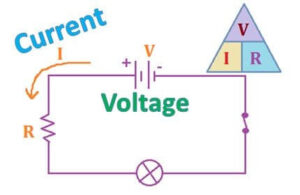
Electric Current Quiz The quiz is designed for the various curriculum students such as GCSE, IGCSE, ISC, IB, ICSE, CBSE and National Curriculum England. Start the quiz and learn science with fun! Quiz Level: Grade 8Total Questions: 20 1 / 40 Find the type of current if it's only flows in one direction? AC Current DC Current None 2 / 40 When a glass rod is rubbed with silk, it acquires a positive charge because ___________. Electrons are removed from it Electrons are added to it Protons are added to it Protons are removed from it 3 / 40 The process by which a chemical change takes place in a substance when electric current is passed through it is called as _________. electrolysis electrodes thermionic conduction electrolysis 4 / 40 Cathode is _______. negatively charged electrode a negatively charged ion formed in the electrolyte positively charged electrode a positively charged ion formed in the electrolyte 5 / 40 Electric current is ____. flow of charge per unit time resistance per unit time work done per unit time all of the these 6 / 40 Silicon is a ________. Super-conductor Insulator Conductor Semi-conductor 7 / 40 In which type of change, we observe alteration only in specific property of matter but not composition? Both physical and chemical change None of these Chemical change Physical change 8 / 40 If the current is 2 Amps and the voltage is 8 Volts, what is the power? 4 Watts 16 Watts 0.25 Watts 10 Watts 9 / 40 When the ends of metal wire are not connected to a battery the _______. protons move in random direction electrons move in random direction electrons move from positive electrode to negative electrode electrons move from negative electrode to positive electrode 10 / 40 Chemical combination involves _________. Combination of any two or more elements or compounds Combination of only same type of elements Combination of only same type of compounds Combination of two atoms 11 / 40 A closed path through which electrons can flow is _________. current voltage circus circuit 12 / 40 Potential difference is measured in _____. ohms amperes columbs volts 13 / 40 Conventionally the direction of the current is taken as _______. the direction of flow of negative charge the direction of flow of atoms the direction of flow of molecules the direction of flow of positive charge 14 / 40 Which of the following is not correct regarding electroplating. In this process electricity is used It is use to produce electricity It is use to provide coating of an electrode It is use to alter the appearance of an objects 15 / 40 If an atom loses an electron, it becomes ________ charged. negatively Neutral positively 16 / 40 Which is an example of the build-up of static electricity? Friction Lightning Generator Electromagnets 17 / 40 An electrolyte is ________. a liquid that conducts electricity a light electric cell none of these a metal 18 / 40 In electrical wire copper is used for electrical conduction mainly because ______. it is cheaper it has a high melting point it is very durable it has low electrical resistaivity 19 / 40 If you place a 50 Volt power source across a 10 Ohm resistor, what will the current be? 0.5 Amps 500 Amps 5 Amps 0.2 Amps 20 / 40 Bakelite is a/an _______. Insulator None of these Semi-conductor Conductor 21 / 40 In the direction of electric field, the electric potential _______. remains uncharged becomes zero increases decreases 22 / 40 When the path of current, starting from one terminal of cell, ends at the other terminal of the cell is broken at some point, then such a circuit is called as _______. open or incomplete circuit closed or complete circuit None of these Either open or closed circuit 23 / 40 The SI unit of current is _______. Coulomb Volt Ohm Ampere 24 / 40 Find the type of current if it's constantly changes direction? AC Current DC Current None 25 / 40 What are all substances made from? Neutrons Electrons Protons Atoms 26 / 40 The existence of a negative charge on a body implies that it has _________. acquired some protons from outside lost some of its protons lost some of its electrons acquired some electrons from outside 27 / 40 Electric bell works on the principle of ___________. magnetic effect of current heating effect of current chemical effect of current all of these 28 / 40 Materials which allow larger current to flow through them are called as _____. Insulator Semi-conductor Conductor Alloys 29 / 40 In an electrolytic cell, the electrode that is connected to the positive terminal of the battery is called as ________. cation anode anion cathode 30 / 40 The unit of energy is ______. Joules Watt per hour Kilowatt per hour Kilowatt 31 / 40 The current in a circuit equals the voltage difference divided by the resistance. Newton's law Voltage law Current law Ohm's law 32 / 40 According to Ohm's Law, current equals the voltage divided by the _________. Capacitance Inductance Power Resistance 33 / 40 What is the standard unit of measurement for electrical charge? Volt Ampere Ohm Coulomb 34 / 40 If you have a 12 Volt battery placed across a 6 Ohm resistor, what will the current be? 18 Amps 2 Amps 72 Amps 0.5 Amps 35 / 40 Potential difference is measured using______. electroscope ammeter voltmeter wattmeter 36 / 40 Good conductors have many loosely bound _________. Electrons Atoms Molecules Protons 37 / 40 In a metallic conductor, electric current is thought to be due to movement of ______. electrons amperes ions protons 38 / 40 When two bodies are charged together by rubbing each other then both of them acquire ___________. None of these Equal and opposite charges Unequal charges Unequal and opposite charges 39 / 40 A 1.5V battery is connected across a metal wire of resistance 3Ω. Calculate the current in the wire. 4.5A 0.5A 3A 1.5A 40 / 40 A closed path that electric current follows is? Batteries Resistance Electric Circuits Voltage Difference Please enter your name below. Name Your score is LinkedIn Facebook VKontakte 0% Restart quiz Exit Send feedback ← Science Quiz Index Series & Parallel Circuits →